Theatre of the Image: Why Chris Glynn’s Nonlinear Journey Inspires Art, Science and Everything In‑Between
2 Apr 2026
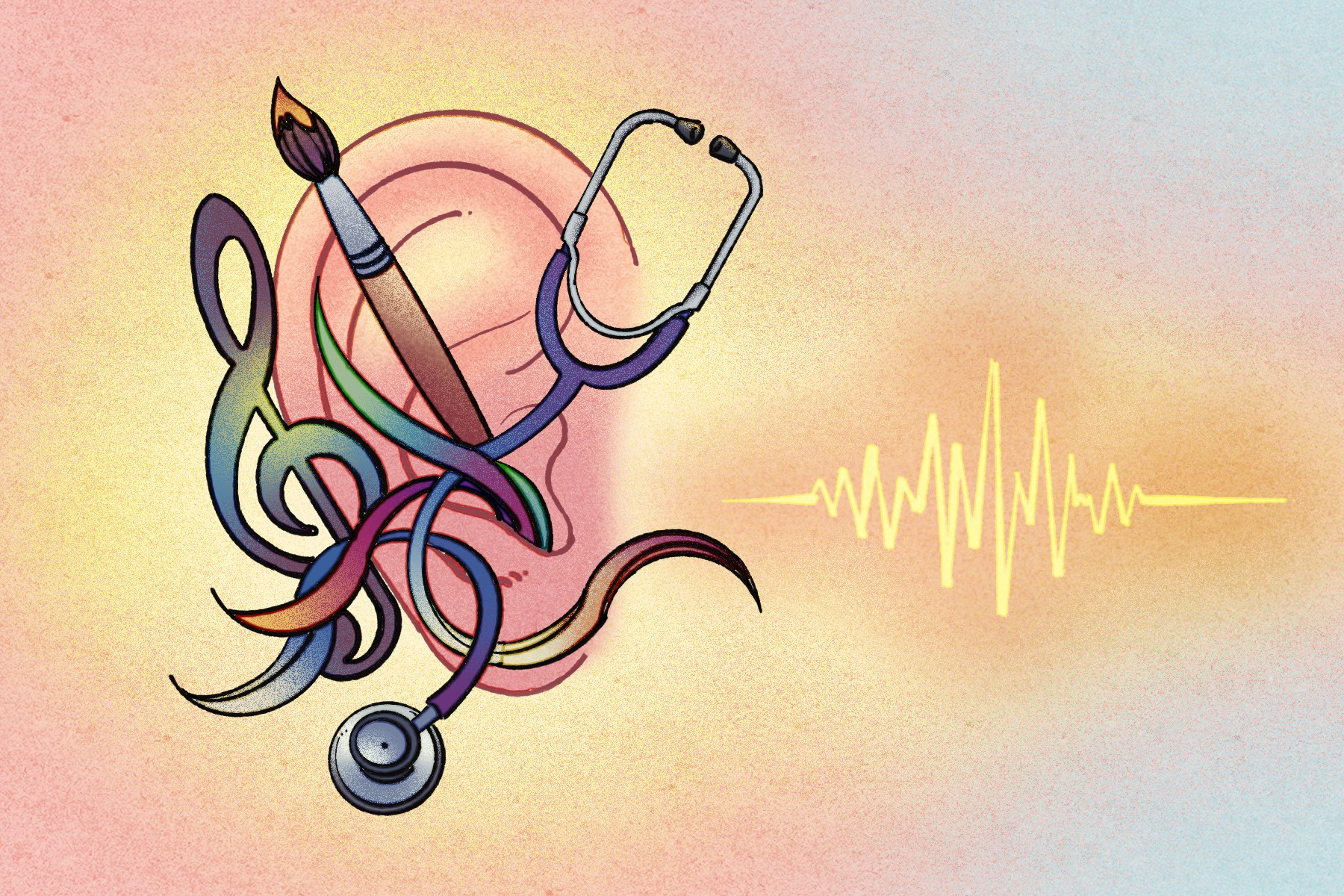
Fieldnotes Stiwdio was a six-month experiment to create a monthly space for artists and researchers to come together, talk, discuss and learn from each other. Because when people share space, so the belief goes, connections spark into place. These sparks can lead to new equations or creative doodles – to collaborations not yet thought possible. And for Chris Glynn, illustrator, actor, thinker of too-many-thoughts, such sparks even inspire ideas such as gorillas believing in angels.
Glynn self-describes as a non-linear thinker and a polymath. Opening the talk with humour and honesty, by owning the pre-emptive apology for what is, in his words, a very chaotic presentation style. Rather than apologising, Glynn performed a power play in a world that desires straight lines and a well-organised career path. Something echoed in Glynn’s very career, where he has been a music teacher, an animator, illustrator, tutor and academic, and now he is back to what he enjoyed as a child: drawing. And acting too. His work is richer because of that thread going back through the decades.
Glynn brought to our minds the fact that theatre is one of the oldest art forms, and its purpose stems from the need to make sense of our existence. For Glynn, that theatre-ness extends to pictures.‘The Theatre of the Image’ is a form of paper-based theatre, in which pictures emerge, disappear, and reappear – a space that looks to visualise the complexity of life. And death. To Glynn, theatre is not a performance, but rather a ritual and a mode of confronting life and death. One such case, was a recent experience Glynn witnessed at the Experimental Cancer Medicine Centre in Cardiff University, where patients received applause simply because they survived several years after chemotherapy. From Glynn’s perspective as a witness and visual documentarian, a stage upon which space for life and death was provided, and by doing so complex conversations were had. And, of course, illustrated by Glynn.
“Maybe a case of survival is sometimes a stronger tale about nature?”
To the writer of this article, new to these worlds and ideas, this concept is a breakthrough in science communication. All too frequently, research is presented in the form of two-dimensional data lacking drama. Glynn says that pictures can be theatrical, and gives an example of particulate motion: science can be acted out. And not necessarily in the flashy sense, but as a play that engages with people with what truly is important. And, to tell the truth, who wouldn’t be glad to have some drama instead of a dull PowerPoint?
Another high point was Glynn's eagerness to collaborate with philosophers, translators, and even death scholars. A colleague, George Gumisiriza, raised two probing questions to Glynn’s work on documenting health and death: Who is lost? What is death? These questions ground the discussion, reflecting the practical thinking. Asking who is absent encourages broader involvement, while considering where death is leads us to important truths in research across medicine, art, and society. Glynn's willingness to tackle these questions shows how art can enrich scientific discourse. Though the topic is weighty, he addresses it with a smile and warmth, keeping the audience engaged by flipping papercut characters on a stage of lights and cardboard.
Science communication should be able to respect human experience as it informs people. In his tale of patients being applauded for surviving cancer, Glynn observed the role of theatre in providing space for life and death. The voice of patients carries more weight than information. The message of this for those who are trying to bridge art and science, is: illustrations and creative projects should raise, lift, magnify those voices, and make research human and unforgettable. And why not be wiser? Talk beyond the numbers, beyond the statistics, beyond the research. Talk about stories of survival. Or, better yet, do not talk at all. Perhaps, just listen.
Glynn’s reflections on listening drew directly from his training in the Meisner technique of acting, where the focus is not on dazzling an audience but on being fully present with another person. In theatre, this kind of active listening allows performers to respond truthfully and create authentic connection on stage. Glynn reminded us that the same principle applies to science communication: you don’t need to be clever or constantly invent something new, you need to pay attention. Listening becomes a performance, shaping how messages resonate with audiences. This approach offers a powerful tool; by listening carefully to researchers, patients, and wider communities, projects can be shaped with greater empathy and impact. And perhaps the most liberating lesson is that, just as in theatre, presence matters more than spectacle; sometimes simply being attentive is enough to carry the story.
Glynn said that he, 40 years into his working life, has started a new career. Reinventing himself yet again. The story about Glynn demonstrates that it is not necessary to pursue careers linearly, but through the layers, with every layer adding more experience to them. His experience is something we can listen to and see what it reveals for science communication as a whole.
We shall finish this article the same way Glynn finished his talk:
“I am out of time. I think you’re done. I’m done. I let you go. It’s a glimpse.”
by Wisha Qaiser
Edited by Ian Cooke-Tapia